


Nigeria’s Inflation Falls to 15.43% as Food Prices Remain a Major Concern
Headline Inflation Eases in July, But Food-Price Pressure Remains Strong
Nigeria’s headline inflation rate declined to 15.43 per cent in July 2026, according to the latest Consumer Price Index report released by the National Bureau of Statistics (NBS).
The July figure represents a 0.48 percentage-point decline from the 15.91 per cent recorded in June 2026.
The latest figure is also significantly lower than the 24.94 per cent recorded in July 2025, although the comparison should be viewed in the context of Nigeria’s rebased Consumer Price Index and updated consumption weights.
While the decline in headline inflation could be seen as positive news for the Nigerian economy, the latest data contains another important message: food-price pressures remain significant.
Food Inflation Remains High
Food continues to be one of the biggest concerns for Nigerian households.
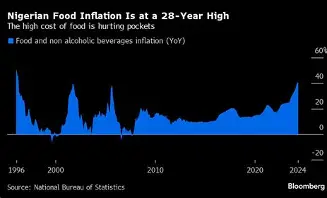
According to the NBS data, food inflation stood at 20.31 per cent year-on-year in July 2026.
More strikingly, food inflation accelerated sharply on a month-on-month basis, rising to 5.56 per cent in July from 3.75 per cent in June.
This means that although the overall annual inflation rate declined, consumers could still experience noticeable increases in the prices of food items.
The NBS identified changes in the average prices of several commodities, including rice, fresh tomatoes, onions, pepper, garri, plantain, beef, eggs, crayfish and other food products, among factors behind the monthly increase.
Why the Drop in Headline Inflation Matters
Headline inflation measures the overall change in the prices of goods and services consumed by households.
A decline from 15.91 per cent to 15.43 per cent means that the annual pace at which the overall price level is increasing has slowed.
However, it does not mean that prices have returned to the levels Nigerians were paying several years ago.
In simple terms, inflation falling means prices are increasing more slowly; it does not necessarily mean that prices themselves are falling.
This distinction is particularly important for households dealing with food, transportation, rent and other everyday expenses.
Monthly Inflation Also Moderated
The NBS reported that month-on-month headline inflation stood at 1.57 per cent in July, compared with 1.66 per cent in June.
That represents a 0.09 percentage-point decline.
The figure suggests that the monthly pace of overall price increases moderated slightly during July.
However, the much stronger monthly increase recorded in food prices shows that the improvement was not evenly distributed across all categories.
Core Inflation Declines
Another important part of the July report was the movement in core inflation.
Core inflation, which excludes some volatile components such as agricultural produce and energy prices, stood at 14.97 per cent year-on-year in July.
On a month-on-month basis, core inflation declined to 0.15 per cent, compared with 1.66 per cent in June.
The moderation in core inflation provides another indication that some underlying price pressures have eased.
However, the continued strength of food inflation remains a major challenge for households.
Food Remains the Largest Contributor
Food and non-alcoholic beverages remained the largest contributor to Nigeria’s headline inflation.
The category contributed 6.18 percentage points to the year-on-year headline inflation figure.
Restaurants and accommodation services contributed 1.99 percentage points, while transport contributed 1.64 percentage points.
This highlights the important role that food prices continue to play in Nigeria’s cost-of-living debate.
Inflation Differs Across States
The national inflation figure also masks significant differences between states.
The latest NBS figures show that Adamawa recorded the highest year-on-year headline inflation rate at 33.03 per cent, followed by Yobe at 25.21 per cent and Anambra at 23.99 per cent.
Nasarawa recorded the lowest year-on-year headline inflation rate at 7.86 per cent, while Kebbi and Borno both recorded 9.12 per cent.
The differences demonstrate that Nigerians in different parts of the country are not necessarily experiencing price changes at the same rate.
Urban Households Continue to Face Higher Inflation
The NBS report also showed a difference between urban and rural inflation.
Year-on-year urban inflation stood at 16.12 per cent, compared with 13.77 per cent for rural areas.
Month-on-month urban inflation declined from 2.13 per cent in June to 1.90 per cent in July, while rural month-on-month inflation increased from 0.52 per cent to 0.78 per cent.
These differences are important because households in urban areas often face different transportation, housing and service costs compared with rural households.
What Does This Mean for Nigerians?
For ordinary Nigerians, the most important question is whether the inflation slowdown will eventually translate into lower pressure on household budgets.
The answer may not be immediate.
A decline in headline inflation is generally positive because it indicates that the pace of price increases is slowing.
But with food inflation still above 20 per cent year-on-year and monthly food inflation rising sharply, many households may continue to feel significant pressure when purchasing basic necessities.
The Bigger Economic Picture
Nigeria’s latest inflation figures provide a mixed picture.
On one hand, headline inflation has continued to moderate, moving from 24.94 per cent in July 2025 to 15.43 per cent in July 2026.
On the other hand, food prices remain a major source of pressure for consumers.
The government and economic policymakers will therefore face the challenge of maintaining the progress recorded in headline inflation while addressing the factors contributing to high food prices.
Agricultural production, transportation costs, supply chains, exchange-rate conditions and energy costs can all influence the prices consumers ultimately pay.
What Happens Next?
The next inflation report will be closely watched for evidence of whether the downward movement in headline inflation can continue.
Economists and policymakers will also pay close attention to food inflation because of its direct impact on household welfare.
If headline inflation continues to decline while food-price pressures ease, Nigerian households could begin to experience a more meaningful improvement in the cost of living.
For now, however, the July figures present a mixed message:
Nigeria’s headline inflation is slowing, but food prices remain a major challenge.
The headline number is encouraging, but for millions of Nigerians, the real test will be whether the cost of everyday living begins to feel more manageable.