



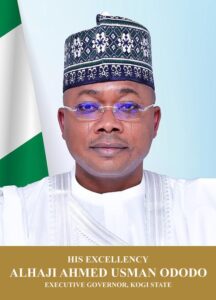
By Jacob Edi
There is a peculiar way Nigerians discuss government. We often spend more time discussing politicians than the policies they pursue, more time analysing political alignments than examining what those alignments ultimately produce for the citizen. Who is with the governor, who has fallen out with him, who is moving where and who is positioning for what often dominates public conversation. Yet beneath this political theatre, ordinary life continues. Farmers are trying to get their produce to market, businesses are struggling with rising costs, parents are worrying about school fees and young people are looking for opportunities in an economy that does not always provide enough of them.
This is why it is useful, from time to time, to step away from politics and examine governance on its own terms. In Kogi State, particularly, the question worth asking is not simply how much political activity surrounds Governor Ahmed Usman Ododo, but what his administration is trying to achieve and whether the direction it has chosen offers a credible basis for improving the economic and social condition of the state.
That distinction matters because the administration came into office on January 27, 2024, at a particularly difficult economic period. Inflation was high, fuel prices had increased, exchange-rate instability was affecting businesses and households, and the cost of production had risen sharply. Government consequently faced two competing pressures: it had to respond to immediate hardship while also investing in the productive foundations that could reduce the state’s vulnerability over time. This piece, therefore , is to analyse the economic transformation Koi has witnessed under governor, Ahmed Usman Ododo and the political dynamic arising therefrom within the framework of identifiable challenges in the area of workers’ welfare, agriculture, infrastructure, education, healthcare, security, enterprise development, digitalisation, investment promotion and social protection.
The significance of this approach is that it treats development as a process rather than a collection of government activities. That is an important distinction in a country where the commissioning of a project can sometimes be mistaken for the completion of development itself. A budget represents an intention to spend; a project is an output. Neither necessarily constitutes an outcome. The real test is whether the intervention changes something in the lives of citizens and whether that change can be sustained. This policy analysis makes this distinction between activities, outputs, outcomes and impact and argues that serious assessment of government must go beyond the number of projects executed or the amount of money committed.
This provides a useful lens through which to examine the Ododo administration.
Take infrastructure, for example. Kogi’s geographical position has long been recognised as one of its greatest economic advantages. Located around the Niger-Benue confluence and connected to important national transportation corridors, the state has considerable potential as a logistics, agricultural and commercial hub. And even though geography by itself does not create prosperity, the mere fact fact that commercial vehicles pass through Kogi does not automatically translate into wealth for Kogi communities.
The important question is what the state does with that advantage. Infrastructure becomes economically meaningful when it reduces the cost and time of moving people and goods, connects farms with markets, links communities with commercial centres and makes it easier for investors to establish productive enterprises. A road leading to a productive agricultural area has a different economic value from a road that exists principally as a visible public asset. The Ododo government’s policy framework therefore treats infrastructure not merely as construction but as an economic platform capable of enabling wider productivity.
Agriculture provides an even clearer illustration of why policy should be judged by outcomes. Nigerian governments have historically devoted considerable attention to distributing fertiliser, seedlings, machinery and other agricultural inputs. Such interventions may be necessary, but they cannot by themselves constitute agricultural transformation. The farmer’s real concerns are whether production has increased, whether costs have fallen, whether harvested produce can be stored and transported and whether it can ultimately be sold at a profitable price.
This philosophy is anchored on a mindset that frames farmers as part of an economic chain rather than simply a recipient of government assistance. To demonstrate this, the governor didn’t just personally monitor distribution of fertilizer and other farming implements he made it clear such government action should be measured along party lines but for the people of Kogi state to benefit. This is clearly a departure from the past.
For Kogi, this has considerable implications. The state has agricultural potential, but the objective should be to move beyond producing raw commodities towards an ecosystem in which production, storage, processing, transportation and marketing reinforce one another. When that happens, agriculture can generate jobs beyond the farm and create opportunities for small businesses, transport operators, processors and other participants in the value chain. This is the mindset of the government at the moment.
The same principle applies to Kogi’s mineral resources. The state possesses significant mineral potential, but extraction alone does not amount to industrialisation. If minerals are simply taken out of the ground and transported elsewhere for processing, much of the economic value leaves with them. The greater opportunity lies in moving progressively from extraction to processing, manufacturing and market development. Millions of naira has been spent by the government in formalizing the exploration protocols. This will set the stage for the state taking full advantage of the presence of critical mineral resource under Kogi soil.
That approach would require responsible mining, environmental safeguards, community engagement, appropriate infrastructure and stronger participation by local enterprises. It would also require government to recognise its proper role. The state does not necessarily have to become the operator of every economic activity. Its more useful role may often be to create the conditions under which private capital can operate effectively by addressing issues such as land, security, infrastructure, community relations and administrative predictability.
The treatment of workers also deserves to be considered within this wider policy framework. The implementation of a N72,500 minimum wage as well as tax waivers for state civil servants in 2024 was an important response to the erosion of purchasing power. But its economic significance goes beyond the salary received by an individual worker. Salaries circulate through local economies as workers spend on food, transportation, housing, education and other household needs.
The main objective here is to have a more motivated, better trained and more accountable public service capable of translating expenditure on personnel into better services for citizens.
This is where the concept of shared prosperity becomes particularly relevant. Shared prosperity does not imply that everybody should have the same income. It means widening the opportunity for more citizens to participate in economic progress. In practical terms, that should mean a farmer becoming more commercially viable, a young person acquiring skills that lead to employment or enterprise, a small business moving beyond survival and vulnerable households gradually becoming less dependent on emergency support.
There is another aspect of the Ododo policy direction that deserves attention, particularly because it is often overlooked in Nigerian political discourse: continuity. Development is cumulative. States do not begin again every time a new administration takes office. Useful projects inherited from a previous government should be completed, successful programmes should be strengthened and ineffective interventions should be redesigned or discontinued. Of course, this is a major policy plank of the Ododo administration.
This is not merely an administrative principle. It is a development principle that meets international best practices.
A state that constantly abandons programmes because political ownership has changed will spend much of its resources restarting rather than progressing. What matters ultimately is not which administration receives the political credit but whether the institution and the citizen receive the benefit.
For Ododo, it is about the state. His development agenda and policy options reflects a Kogi after his tenure and thereby providing an opportunity to think of Kogi’s development as a continuum in which successive administrations should be able to improve upon what they inherit rather than repeatedly starting from scratch.
And for Governor Ododo, this may prove to be one of the more consequential aspects of the administration’s policy legacy. It is the hallmark of great leaders.
This is also why the current conversation about Kogi deserves to be broader than the familiar contest between supporters and critics. Both sides of politics have their uses, but neither applause nor opposition provides a sufficient measure of development. The more useful assessment is whether the state is becoming more productive, whether its infrastructure is supporting economic activity, whether agriculture is becoming more commercially viable, whether businesses can survive and expand, whether young people are acquiring useful skills and whether public institutions are becoming stronger.
These things take time.
An agricultural value chain cannot be created by a single ceremony. Industrialisation cannot be achieved by announcing an investment agreement. Human capital development cannot be measured immediately after a training programme. Infrastructure requires maintenance long after commissioning. Institutions require consistency before they develop the capacity to function independently of political personalities.
For Kogi, the opportunity is substantial. Its geography can support logistics and trade. Its agricultural resources can support food production and agro-processing. Its mineral resources can support industrial activity. Its human population can support a growing service economy. But none of these possibilities will translate automatically into prosperity. They require consistent policy, credible institutions, private investment, reliable data and the patience to allow reforms to mature..
In that sense, the real question surrounding Kogi is not simply what Governor Ododo has done. It is whether the direction being pursued is capable of producing a more productive and competitive state over time.
That is a question that transcends political camps.
When the political arguments eventually subside, they will still have to live with the roads, use the hospitals, send their children to school, cultivate their farms, run their businesses and search for opportunities for their families.
That is where government ultimately meets the citizen.
And that is where policy, rather than politics, has the final word.