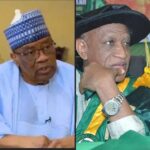



- BY ABU NMODU, Ph.D
The 85th birthday celebration of former Military President, General Ibrahim Badamasi Babangida (IBB), has come and gone, but the deluge of tributes and reflections it generated will likely continue for some time. Commentators have attempted to dissect his life, career and legacy. Yet, even the most rigorous analyses often fall short of capturing the true essence of his enduring influence and enigmatic personality.


The recent launch of his highly anticipated memoir also generated significant public discourse. Still, many observers argue that even a book of that magnitude cannot fully unveil the man behind the myth. For any journalist who has covered Niger State, the former Nigerian leader’s residence, affectionately dubbed “Uphill 1” during his “stepping aside” years, served as a primary source of history.
Long before the memoir was published, the seeds of its contents were regularly sown during the exclusive interviews he granted to the local press corps. Until recent years, journalists in the state eagerly anticipated these annual interactions ahead of every August 17, his birthday.
Interviewing IBB, however, requires more than standard reporting skills.
A journalist must wear a sharp thinking cap and master the art of interpretive journalism.
To extract a compelling lead, headline and body from an interview with him, one must carefully listen to, interpret and decode his words.
While Baba boasts a warm, magnetic personality and is genuinely comfortable around media practitioners, he is rarely a “journalist’s delight” when it comes to providing straightforward and overt headlines. He speaks eloquently, but the direct answers required to give a story instant leverage are often deliberately withheld.
I recall an encounter with him ahead of the 2007 presidential election regarding his rumoured political ambitions. At the time, his family was facing intense political hostility from the administration of the day, culminating in the brief arrest of his son, Mohammed. I deliberately asked the General about his instinct and drive to contest.
He looked at me, smiled and simply said: “Don’t be naughty; you are far too young to probe my intuition.”
That interaction cemented my understanding of his psychological framework. IBB resists external psychoanalysis. He masterfully conceals his instinctive reasoning behind a disarmingly warm exterior, making his interlocutors comfortable enough to reveal their own thoughts while keeping his own close to his chest.
This trait bears some resemblance to the psychosocial theories of Sigmund Freud, who famously used the analogy of an iceberg to represent the human mind. In Freud’s model, the conscious mind is merely the visible tip above the water, while the vast and powerful unconscious mind remains submerged.
IBB aptly demonstrates a similar complexity. Much of his strategic thinking and motivation remains hidden beneath the surface, yet it often determines his public responses, political calculations and engagement with his environment.
Public perception of the former Military President remains deeply polarised. Among journalists in Niger State, he is fondly called “Baba.” He is intensely loved by many, but not by others. IBB himself acknowledged this sharp divide during an interview we had with him to mark his 70th birthday.
While I will not dwell on the sociopolitical roots of these conflicting perceptions, it is fascinating to observe how he reacts to outright hostility. We in the Niger State press corps know that much of the negativity directed at him is sometimes rooted in detached conjecture. Yet, Baba possesses a rare ability to wave aside malice and falsehoods that would ordinarily crush the spirit of lesser men.
No matter how grim or cynical the public discourse becomes, he consistently displays the magnetic charisma of a vintage General trained to dominate his environment.
This innate quality undoubtedly contributed to his rise to the apex of Nigerian leadership. He possesses a rare blend of emotional intelligence and resilience, enabling him to engage friends and foes without easily revealing his next move.
His governance style, particularly his ability to assemble a galaxy of intellectual “eggheads” to run the country, can be described as maverick.
His approach aligns, to some extent, with the theories of Max Weber, one of the founding fathers of sociology. While Weber did not explicitly use the term “maverick,” his concept of charismatic authority explains how leaders can depart from established institutional norms and mobilise people around a powerful personal vision. Weber recognised charisma as a potent catalyst for social transformation, even when it exists in tension with rigid, rule-based bureaucracies.
Years ago, I interviewed his childhood friend and veteran broadcaster, Alhaji Ibrahim Ahmed. He vividly recalled visiting IBB at the war front near Okigwe during the Nigerian Civil War, just a day before the General sustained a serious injury.
Despite the intense operational pressure, Alhaji Ahmed said IBB remained remarkably calm, advising his friend to return home to safety ahead of an impending attack.
That battlefield experience left the General with shrapnel that he carried for decades, but it also helped forge the legendary composure for which he became known.
Historical accounts show that, as a young officer, Babangida was one of the youngest individuals appointed to the Supreme Military Council. While many of his peers preferred the immediate visibility and influence that came with serving as Military Governors or Federal Ministers, IBB chose to operate within the highest military decision-making organ, quietly positioning himself for the future.
His most defining moment as a young officer remains his legendary bravery in foiling the bloody Dimka coup of 1976. Beyond physical courage, that episode highlighted his capacity for emotional intelligence, strategic thinking and crisis management.
He remains a deeply forward-thinking strategist, acutely aware of how his past actions, present words and future omissions can shape his legacy.
Reflecting on my years covering his activities during his post-presidency era, I have arrived at three definitive conclusions.
First, you cannot rely on “insider sources” with precision when dealing with IBB. There is no such thing as an insider. He rarely compromises his strategic position through careless words or actions.
Second, standard, routine reporting will not yield a breakthrough interview with him. A journalist must either compel him with sharp, leading questions or settle for deep and contextual interpretation.
Third, never allow him to fully read your psychological mindset during an interview. If you do, his charm can disarm you entirely, causing you to lose sight of your editorial objective and miss the news.
Ultimately, no matter how hard you try to steer the narrative, the former Military President will always remain in control of the room. He remains incredibly sharp, often anticipating your perspective before you even utter a syllable.
As I wish him continued long life, good health, divine wisdom (Hikmah), mercy (Rahman) and light (Noor), I submit that a journalistic perspective alone will never be enough to fully comprehend the General.
Perhaps only another memoir from the man himself will suffice.
Abu Nmodu is the Niger State Correspondent of Leadership Newspaper and Chairman of the Nigeria Union of Journalists (NUJ), Niger State Council.